
Pursue an ethnography of a locale/shop of your choice within Lincoln town centre. In what way is that locale/shop “dis-embedded” from its local surroundings? And in what ways is it then “re-embedded” within various national/international/global flows?
In this report, I will be using the global franchise restaurant, McDonald’s, to pursue a detailed ethnography. Including theories supporting how that business is ‘disembedded’ from the local area and then ‘re-embedded’ within wider global flows. I will focus on the franchise’s reliance on bureaucracy to function, its use of wider global flows to appeal to local customers and how these are hidden to protect the brand.
McDonald’s is an international restaurant franchise, according to the McDonald’s Corporation website (2018), ‘McDonald’s has locations in 101 countries. More than 36,000 restaurants around the world and they serve 69 million people every day’ (Rosenberg, 2018). Due to the massive scale of the franchise, they have large global flows within society. Their franchise has spread rapidly across the globe since going public in 1965. An investment of $2,250 (£1,500) in 100 at that time (or £12,000 in 2017) has grown to 75,000 shares worth approximately $9 million (£8 million) as of the market close in December 2016, McDonald’s corporate website, (2018, N.P.).
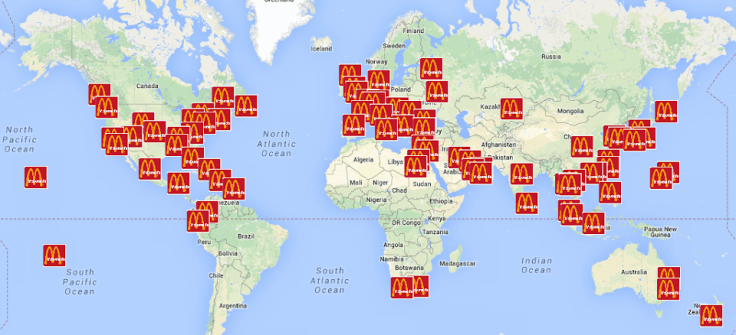
Giddens (1990) theorised how an increase in globalisation can transform the relationship between the location we inhabit and wider global flows within the world. Dis-embedding is the idea of lifting up a business from its local geography and then restructuring or re-embedding it back, but with greater international flows and connections.
I focused my ethnography on a McDonald’s chain located in the town centre of Lincoln. I used research in order to study how McDonald’s is dis-embedded from its wider global flows and then re-embedded into the local flows and the connections of Lincoln (Giddens, 1990).
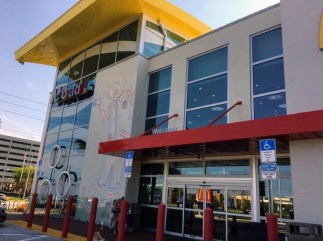
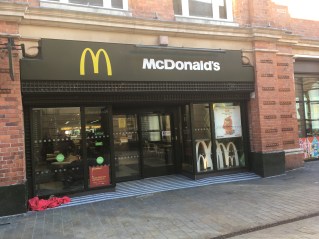
The Lincoln McDonalds is located on the high-street, next to two major transport stations; these connect people to locations all around the UK. Potential customers will flow and connect through Lincoln on commutes. This connects Lincoln’s McDonalds with local and national customers around the UK, this increases it’s wider flows and connections.
McDonald’s is a global company but must be dis-embedded from its global flows to be able to target the local market of Lincoln. The business is then re-embedded into Lincoln, affecting the restaurant’s predictability, automation and efficiency (Ritzer, 2010).
An increase in globalisation can be seen as an ever-increasing rationalisation and ordering of society (Weber, 1964). This increase in globalisation has placed a greater reliance on the organisation of bureaucracies. In order for bureaucracies to be successful, they need to operate anywhere irrespective of context.
In order to mass produce the McDonalds product, a bureaucracy will use calculability in order to turn customers/produce into calculatable numbers to increase predictability and efficiency. Lincoln McDonalds isn’t as technologically advanced as other McDonald’s chains such as the Sleaford chain which uses an ordering numbered system. This could be due to the larger volumes of customers that the Sleaford chain receives due to its location being on a roundabout that is connected to multiple UK regions.
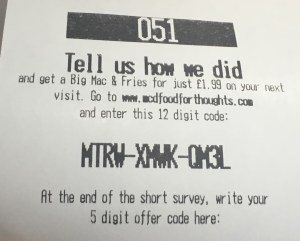
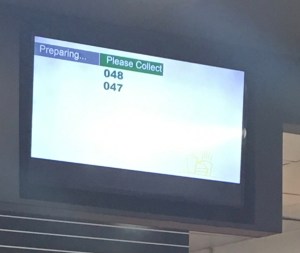
Ritzer’s (2010) theory on McDonaldization argued that as a business increases in franchise and global flows, this creates a greater need for bureaucracy. McDonalds’ uses bureaucracy in order to meet customer expectations and needs across multiple countries and locations. Bureaucracy is key when wanting a franchise to work, as its main purpose is to successfully transfer the same standards and products/services across the franchise. This also allows McDonald’s to create regulations from a distance that workers must follow, thus creating uniformity across all chains of the franchise.
McDonald’s has a strict set of standards and guidelines for staff to follow so each chain has uniformity and predictability necessary for a successful bureaucracy (McDonald’s employee handbook, 2018, N.P.).
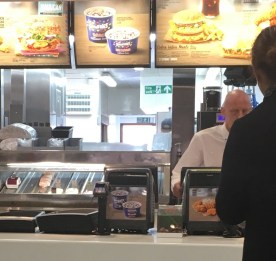

The Lincoln McDonalds staff overall met the standards and regulations stated in the employee handbook during my ethnography research, but some staff didn’t meet the uniform dress code. The staff member in figure 7 wasn’t wearing a logo shirt or a name badge, which was a breach of company rules. This shows a flaw in bureaucracy as similar to Foucault’s (1977) panoptic model theory. When the theory of bureaucracy is placed in the practical world it doesn’t account for the difficulty to control mass amounts of people or employees due to individual variables, thus creating unpredictability in the franchise.
Another issue with the predictability and uniformity of McDonald’s, when re-embedded into Lincoln, is the accessibility of produce. An issue with bureaucracy is that it promises the same standards and services no matter the location, but due to the growth in the franchise and population, the products available for use will adapt and change depending on the location and or regulations placed on an individual chain.
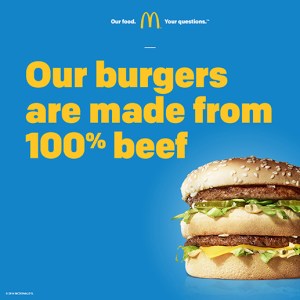
McDonald’s claims, on its corporate website, that they only use 100% British and Irish beef, they claim to work with over 16,000 British and Irish farmers who supply beef to the UK chains, and the farms must adhere to the recognised farm assurance schemes. This was a successful campaign and appealed to local customers in the UK, especially Lincolnshire due to it being a predominately agricultural region, whose customers would be concerned about the products used by McDonald’s. But a recent news article from The Independent (2017) stated that research suggests the cattle used for the production of McDonald’s products are raised on soy-based grains which are mass produced in places such as the Amazon, leading to an increase in deforestation. No mention of this claim is discussed on global Mcdonald’s campaigns or websites, and evidence shows the company is able to use British feed but have continued to use unethical feed due to the cheaper cost (Johnston, 2017).
Another element of dis-embedding is the theory of hiding the company’s global connections to appeal to a local customer base. Phantasmagoria was a form of shadow theatre in the late 18th century. McDonald’s uses a sense of phantasmagory as they hide their global connections with, cattle feed, when they appear negative to the brand, deceiving the customer and allowing for greater global flows.
Lincoln McDonalds is dis-embedded from its local surroundings due to its wider global connections that are mostly hidden from public view. The need for bureaucracy in order for the franchise to be successful hasn’t pre-empted individual variables that will cause unpredictability within the franchise. The business is then re-embedded within the local flows of Lincoln, global campaigns that appeal to Lincoln-based customers are used, but the unethical global connections needed for this are hidden to protect the brand.
References:
Foucault, M., & Sheridan, A. (1977). Discipline and Punish: The birth of the prison. Pg.166-67. Penguin.
Giddens, G. (1990) The consequences of modernity. Cambridge: Polity Press
Harrington, R. (2017). We visit the largest McDonald’s in the US and ate pizza, pasta, and a Belgian waffle- here’s what its like. Business Insider UK. Retrieved from: http://uk.businessinsider.com/americas-largest-mcdonalds-serves-pizza-pasta-sandwiches-2017-5
Johnston, I. (2017). What McDonald’s doesn’t want you to know about its ‘British’ beef. The Independent. Retrieved from: https://www.independent.co.uk/environment/mcdonalds-beef-burgers-amazon-rainforest-deforestation-cargill-bunge-a7741541.html
McDonald’s Official corporation website. (2018). https://corporate.mcdonalds.com/corpmcd.html
McDonald’s Official Employee handbook. Retrieved on 9th January 2019: http://s3.amazonaws.com/scschoolfiles/497/mcdonalds_employee_handbook.pdf
Ritzer, G. (2010). Mcdonaldization: The reader (3rd ed.). Thousand Oaks, Calif.: Pine Forge Press.
Rosenberg, M. (2018). The number of McDonald’s Restaurants Worldwide. Thought Co. Retrieved from: https://www.thoughtco.com/number-of-mcdonalds-restaurants-worldwide-1435174
Weber, M. (1964). The theory of social and economic organization (Free press paperbacks series). Free Press of Glencoe.
 SOC221 - Advanced Social Thought Blog
Leave a comment